
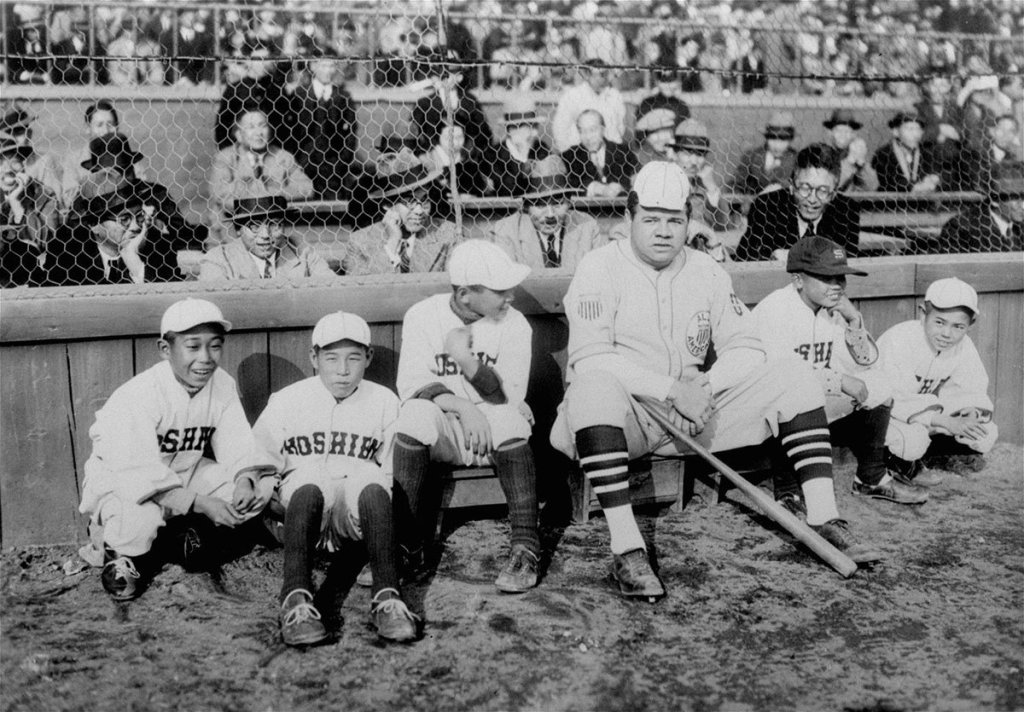
Many people mistakenly believe that baseball was brought to Japan, or atleast became popular, with the famous group of MLB players that was sent over in the Japan tour of 1934. However, that isn’t necessarily true. Baseball was already incredibly popular in Japan for quite some time before that.
For those who aren’t familiar, Babe Ruth, Lou Gehrig, Jimmie Foxx, and others, came over to Japan in 1934 and played barnstorming games against different local teams including the Japanese all-star team. While this helped cement baseball as the most popular sport in the country, the history of baseball in Japan has a lot more to it.
Beginning of baseball in Japan
Baseball was introduced to Japan more than 60 years earlier in 1872 by an American professor teaching English in Tokyo. However, unlike America which already had competitive leagues and teams in the 1800s and a full blown and modern league and championships by 1903, Japan’s first professional competitions only occurred starting in the 1920s.
From a historical perspective, baseball likely wouldn’t have come to Japan if not for one of the most important periods in Japanese history that started just 4 years earlier, the Meiji era, or “the Enlightened” era.
Until the year 1868 Japan was a very closed feudal society with limited trade and contact with the outside world, which obviously affected their growth and economy. When Emperor Mutsuhito (Meiji) gained power in 1868, he opened up Japan to modernization and globalization and this allowed more ideas and culture to come to Japan – including the great game of baseball in 1872.
From 1872 to the early 1900’s there aren’t many records of games or leagues, but people still played for fun throughout Japan.
First attempts at establishing professional baseball: 1920-1934
In the early 1900’s there were several attempts to start professional leagues in Japan, but with little success – mostly for financial reasons. Professional teams were started and shut down on and off starting in 1920. There were also a few Japan tours made up of American ballplayers and there were even tours to Korea to try to get the game going there.
One very important update during the 1920’s was the establishment of the national high school baseball tournament, or the “Spring Koshien”, that first started in 1924. While this might sound like a small milestone, the tournament is a huge deal in Japan until this day and is engrained in Japanese baseball culture.
Overall, the 1920’s were not successful in establishing any sort of professional baseball, but the popularity was growing both in Japan and throughout Asia.
US baseball tour of Japan: 1934
In 1934 this group of legendary MLB players came over to Japan to help promote the game. Some people say the tour was political, as US-Japan relations weren’t great and the US wanted to calm things down.
Another reason may have been strategic. One of the least impressive players on the tour – a Jewish 3rd string catcher named Moe Berg who ended up becoming a CIA spy during World War 2 – filmed many strategic buildings and the layout of Tokyo harbor which was used against Japan later on in the war.
No matter what the reasons were for the trip, it was extremely successful in terms of baseball.
Japan put together an all star team who played against the American players, and the games were packed with huge crowds of fans as well as tons of people following the American players around everywhere they went. There was an estimated crowd of over 500,000 who came just to greet Babe Ruth and the other players when they arrived! After all, how can you not be entertained by a large, loud-mouthed, home run hitting American legend playing against a group of quiet, respectful Japanese players?
Although the American team won all 18 games pretty easily, it was a huge success for the game of baseball in Japan. The all-star team that Japan put together stayed together after the tour and became the Yomiuri Giants, the most successful and famous team in Japanese baseball.
First Successful Professional League: Japanese Baseball League (1936-1949)
Two years later the Japanese Baseball League (JBL) was formed which lasted from 1936-1949. There were 7 original teams from the economic center of Japan – such as the cities of Tokyo, Osaka, and Nagoya. The Yomiuri Giants (made up of the all stars from 1934) absolutely dominated this period, winning 9 out of 14 championships, including 6 in a row from 1938-1943.
The JBL changed almost every year of its existence, with the number of games ranging from 35 games in 1944 to 140 games in 1948, and there were hardly any two years with the same amount of games played.
But this era was mostly defined by World War II, which greatly affected every aspect of play. Many players went to fight (72 professional ballplayers died in the war), English team names were outlawed, the 1944 season was shortened and the 1945 season was canceled altogether, and even the baseballs were changed in order to conserve rubber for the war effort.
In short, there was not much stability in this period. It’s safe to say baseball was not a priority for most people because of the cult-like nationalism that swept the country during the war period while their country was fighting extremely bloody battles against the US and its Allies.
Here are some interesting aspects of the Japanese Baseball League:
- The champion was determined by the one team with the best record at the end of the season. There were no playoffs at all.
- In 1947 there was a rival league called the Kokumin League. They had 4 teams, played just 30 games, and disbanded that same year.
- James Bonner was actually the first African American to play professional baseball outside of the Negro Leagues. He started playing in the Japanese Baseball League in 1936, 11 years before Jackie Robinson made his debut for the Dodgers.
At the end of the 1949 season, the JBL implemented some big changes and converted into the Nippon Professional Baseball League (NPB).
Beginning of the NPB: 1950’s
The biggest difference that differentiated between the NPB and the former JBL was that starting in 1950, professional baseball was divided into 2 leagues, the Central League and the Pacific League. This created the first Japan Series where the top team from each league played each other for the championship, instead of the one team with the best record automatically winning it all, like in the JBL.
The two original professional teams from the 1934 American ballplayer tour – the Yomiuri (Tokyo) Giants and the Hanshin Tigers – along with 2 more JBL teams, made up the core of the Central League.
Four other teams from the former JBL made up the core of the Pacific League, all of which are now either extinct or formed into modern day teams with different names or in different cities.
The 1950’s were characterized by a lot of teams joining the league, disbanding, or merging together. At the peak, there were an uneven 15 teams (8 in one league and 7 in the other). But after all of the mergers the league was down to the modern day number of 12 teams by 1960.
NPB from 1960 – 1979
The 1960’s and 1970’s were more stable in terms of the teams, but there were still plenty of changes and even some scandals during this period.
You can’t talk about this era of Japanese baseball without mentioning one of the most dominant runs in professional sports history – the Yomiuri Giants. Led by Sadaharu Oh, the all-time Japanese baseball home run leader with 868 longballs, the Giants won nine consecutive(!) Japan Series championships from 1965-1973, and 11 altogether in this period.
Other than Oh it was also the time period that most of the best Japanese baseball players played in and many of the records still stand from then.
Other than Oh and the Giants winning year after year, this period was also known for its betting scandal of 1969-1971 where multiple teams and players bet on and lost games on purpose for money. This did not go well with the fans, especially in a country whose culture is famous for honesty and respect, and the game took a huge hit. A few teams were forced to sell, many players were banned for life, and there was a big attendance and popularity drop.
As a result of this, the league made some changes to try to bring back its popularity.
Here are some other interesting occurrences from the NPB in those years:
- In 1964 Masanori Murakami became the first Japanese player to play in the MLB. Although he was a pretty successful relief pitcher for the San Francisco Giants (5-1, 3.43 ERA with 100 strikeouts in just under 90 innings), he only lasted 2 years in the majors due to a contract dispute. Interestingly enough, another Japanese player wouldn’t play in the MLB for another 28 years after him.
- In 1975, the Pacific League adopted the Designated Hitter. Being that the gambling scandal mostly affected the PL, they tried this tactic to bring back some fans. Until today, the DH is only used in the PL while pitchers in the Central League still hit.
- From 1973-1982 the Pacific League adopted a playoff type format where the best team from the first half of the season played the best team from the second half of the season to determine who would go onto the championship. This was a precursor to the modern Climax Series playoff format. The Central League didn’t do this and the team with the best record continued to make it to the Japan Series automatically.
NPB from 1981-2003
Japanese baseball of the 1960’s and 1970’s was dominated by the Yomiuri Giants, but the 1980’s and 1990’s belonged to the Seibu Lions. The team from Northwest Tokyo won eight of the 13 Japan Series championships in between 1982-1994 and received the nickname of “Invincible Seibu”.
There weren’t many big changes in the NPB in this period in terms of team expansions, playoff format, or rule changes. But it did mark the beginning of many foreign players coming to play successfully in Japan as well as many Japanese players making it in the MLB.
In 1984, Greg “Boomer” Wells became the first foreign born player to win the Triple Crown in Japan, and also won the MVP that year. Ralph Bryant and Randy Bass – who later became a member of the Oklahoma Senate – were a few other successful foreign players in the 1980’s and 1990’s in the NPB.
The success of these players and others caused the NPB to create a limit of four foreign born players that are allowed to play for each team starting in 1998. In 2002, this rule was changed to include no more than three out of the four players to be pitchers or position players.
In 1995, Japanese pitcher Hideo Nomo went from the NPB to the LA Dodgers, and he was an immediate success. He won Rookie of the Year in 1995, started the All Star Game that year, and threw a no-hitter in 1996. Hideo Nomo was incredibly popular and fans loved his unique “tornado” windup and the idea that a Japanese player can dominate in America.
Nomo opened the floodgates for Japanese players to come to the MLB, and also caused the MLB to create the posting system in 1998 to organize the way it happens.
In 2001, Ichiro Suzuki signed with the Mariners, and immediately became a superstar. He became just the second player to win the MVP and Rookie of the Year in the same year and then went on to beat the single season hits record in 2004 with 262.
Ichiro retired with over 3,000 MLB hits and holds the professional baseball hits record with 4,367 if you combine his time in the NPB with the MLB.
In 2003 Hideki Matsui became the first successful Japanese power hitter in the MLB and won the World Series MVP in 2009 with the Yankees.
By the early 2000’s baseball in both Japan and America enjoyed the popularity of players coming to play successfully in each others’ country. But there were big changes coming to the NPB the following season…
Modern NPB: 2004 – Present
The 2004 season was filled with changes. It started with two Pacific League teams trying to merge due to financial difficulties. Shortly afterwards, two more PL teams wanted to merge due to finances and this would have created a very uneven number of four teams in the PL while the CL would remain with six.
Many of the owners wanted this, as the Central League was far more profitable than the Pacific League. In the NPB there is no revenue sharing like there is in the MLB, so the CL makes far more money thanks to the famous teams such as the Yomiuri Giants and the Hanshin Tigers playing there.
The players didn’t want one league as they felt this would harm their player rights and they threatened a strike. The strike lasted just one weekend in September, 2024, and the players and owners were able to come to an agreement.
Although the merger in question did go through – the Osaka Buffalo and the Orix Blue Waves became one team – the NPB agreed that they would keep the two league format, as well as make it easier for a new team to join in order to keep the leagues at an even 6 teams a piece.
In addition, they worked out a draft system in which the players that were affected by the team mergers would still be able to play in the NPB the following year.
There were a few more big changes starting in the 2005 season:
- The Tohoku Rakuten Golden Eagles became the newest NPB team in 2005 and they play in Sendai, on the Northeastern coast of Japan.
- Another change was the adoption of interleague play, once again trying to help the Pacific League get some of the popularity that the more profitable Central League teams enjoy.
- The Pacific League also introduced a new playoff format where the two and three seed teams play each other in a best of 3 playoff series. The winner of that goes on to play the one seed in a best of 7 series for the chance to go to the Japan Series against the Central League winner. In 2007, the Central League adopted this playoff series as well and it became known as the “Climax Series”.
- From 2010-2020, the Fukuoka SoftBank Hawks won 7 Japan Series titles and mostly dominated the 2010s.
Modern Japanese baseball wouldn’t be the same without mentioning Shohei Ohtani, as the two way superstar is renewing the popularity of baseball collaboration between America and Japan once again.
International baseball goes both ways with Japan. In 2013 Wladimir Balentien, an international Curacaoan-Dutch outfielder broke the single season home run record with 60 longballs.
Overall, Japan has proven itself as an international baseball powerhouse by making it to the championship in all 5 World Baseball Classics and winning 3 of them, as well as winning Gold in the Tokyo Olympics in 2021.
Baseball continues to be the most played sport in Japan. The NPB is becoming more popular internationally, there are now two minor leagues, and the yearly high school baseball tournament in Hanshin Koshien stadium is incredibly important in Japanese culture.
Attending a baseball game in Japan is also an incredible experience, with amazing food, affordable beer, and great energy at the historic stadiums in the NPB.
 Baseball in Japan - Your Guide to Nippon Professional Baseball
Leave a comment