
Every baseball fan loves going to the ballpark. The smell of the fresh grass along with the sounds of the crack of the bat and the cheer of the crowd all bring back good memories of a nice summer night at your favorite ballpark.
Attending a baseball game in Japan is no different. It’s an incredible experience. Each stadium in the Nippon Professional Baseball (NPB) League comes with its own architecture, culinary experience, and cheering section, and going to a baseball stadium in Japan will give you a whole new appreciation for the sport.
What makes Japanese baseball games unique?
Before we get started, just a disclaimer. If you’re in Japan, or planning a trip to Japan, and you’re on the fence about attending a game, do yourself a favor and go. Even if you’re not the biggest baseball fan or you’re short on time, it’s an incredible experience.
And here’s why. Japanese culture is notoriously shy and closed. People don’t talk on the metro, interacting with strangers is not the norm, and you will find it very difficult to get a native Japanese person to open up about anything or show many emotions, even to basic cultural questions that you are curious about.
But Japanese baseball games are the exception. There is something about sports that brings people together, and the ballpark might be the place where you’ll see Japanese people express themselves the most in the whole country.
People cheer and yell (each team has their own singers, cheerleaders, and songs in their cheering section behind the home dugout), fans interact with each other, and the food and beer flow freely.
As an example, when I was at a game in Meiji Jingu stadium in Tokyo, the nice couple sitting next to us talked to us about Shohei Ohtani and their favorite team the Yankees and even gifted us some cool memorabilia. At the same time we shared our hand held fans with a young kid and his mother in order to help them cool off. And this was all with very limited English and quite a bit of Japanese shyness.
Other than professional conversations at restaurants and hotels, this was probably the most interaction we had with native Japanese people in all of our 10 days in the country – and it was all in fun and good spirits.
Japanese Baseball Stadiums vs. American Stadiums
In addition to seeing the fun and interactive side of Japanese culture, baseball stadiums in Japan are simply more fun than American stadiums for a few reasons:
- You can bring your own food and beer in the stadium. While some people might bring their own food into American ballparks, you definitely can’t bring your own beer or alcohol. I didn’t believe it at first but I walked right in with a few cans of beer and my own snacks, and there were even people walking in with open drinks.
- Prices are pretty much the same as outside the stadium. Even if you didn’t have time to stock up on beer or food before the game, there are no $18 Bud Lights or $12 nachos which unfortunately is a common sight at MLB stadiums. I brought in food from outside the stadium thinking that prices would be inflated inside the ballpark, but prices were pretty much the same and maybe even cheaper! Everything was very fresh and affordable, and of course efficient. There are rarely long lines and vendors will even bring beer to your seat while carrying a giant backpack cooler.
- Combining US and Japanese food culture. Some stadiums, such as the ones in Tokyo, have traditional US baseball food like hotdogs and chicken nuggets, but you will also see plenty of really cool Japanese options. You can find ramen, sushi, bento boxes, and Yakisoba (delicious stir fried beef and noodles), but you will also find unique food in each stadium. For example, in Kobe, you can find the exclusive Kobe beef in a meat pie, while in Hiroshima you can find Okonomiyaki, the local pancake type food (although that description doesn’t do it justice). Just like anywhere in Japan, baseball stadiums are yet another place to try delicious food for a good price and great experience. And if you’re with someone who doesn’t care about baseball, the food at most stadiums should be enough of a reason to convince them to go to a game with you.
- Cheering. Japanese baseball is closer to European soccer culture than MLB culture when it comes to fans cheering. Each team has a “cheermaster”, someone who leads the songs, and they are allowed to use a microphone and speakers whenever they want, unlike MLB where there are rules against artificial noise when the ball is in play. All the home fans know the songs and dances and it’s a really cool experience to see what unique cheers each team has (see the Tokyo Yalkult Swallows famous umbrella dance).
I hope I have done enough convincing. Are you ready for the high energy, delicious food, and great baseball? Let’s rank all the 12 current baseball stadiums in Japan.
Best Baseball Stadiums in Japan by order
1) Hanshin Koshien Stadium
- Location: In between Osaka and Kobe
- Built in: 1924
- Capacity: 48,000
- Team: Hanshin Tigers
Hanshin Koshien is the most legendary Japanese stadium by far and should come first on any list. Think Old Trafford for soccer fans or Fenway Park for American baseball. If the year it was built (1924) or the capacity (48,000) didn’t catch your eye then here’s some other cool facts about this ballpark:
- It’s the only professional baseball stadium still around with an all dirt infield.
- Babe Ruth played here on the famous American baseball tour in 1934.
- It was built for the Japanese high school baseball tournament, which is still a huge deal in Japan. In fact, the high school games are even given priority over the professional Hanshin Tigers games if there is a conflict in schedule!
The stadium is said to be built off the design of the Polo Grounds – a big outfield with a wrap-around foul pole and tons of seats in the stands. The stadium also has ivy growing on the outside, giving it a Wrigley Field type vibe.
As far as their “theme” goes, in the 7th inning fans release balloons that fly all over the stadium. They are also famous for making different player themed benton (lunchboxes) as well as great curry and Yakisoba for the food aspect. In addition the ballpark has a museum and tours about the history of the stadium.
It’s hard to overestimate the importance of high school baseball in Japan. Not only is baseball the most popular sport in the country, but Japan is famous for its hard work ethic and honor.
Being able to play in the tournament and winning is a HUGE deal for the young Japanese players, their families, and schools. I was in the country during the high school tournament in August, and every restaurant and bar had the high school games on TV, even if they weren’t big baseball fans.
Koshien stadium is simply the icon of NPB stadiums and honestly it may even be cooler to go to the high school tournament than an NPB game, as the intensity and cheering is supposed to be incredible. But consider yourself lucky if you are able to go there for any game, it truly is a global iconic sports stadium that will leave you in awe.
2) Meiji Jingu Stadium
- Location: Tokyo
- Year built: 1926
- Capacity: 38,000
- Team: Tokyo Yakult Swallows
Meiji Jingu stadium is also a legendary stadium and is definitely in a deserving second place. It’s the second oldest stadium in Japan, and is one of the only 4 remaining professional stadiums that Babe Ruth played in – the others being Koshien above, Fenway Park, and Wrigley Field.
Although it’s almost a century old, Meiji Jingu stadium seems like it’s in great shape and has a really cool old school feel with a modern view and amenities. The only reason it’s not the best stadium is because nobody can take away the legendary status of Hanshin Koshien.
The home team Yakult Swallows are kind of like the Mets – a historically bad team with a few good seasons, with a far more successful and famous team stealing the show across town in the Tokyo Giants (comparable to the Yankees).
But the games here have an incredible vibe. The Swallows’ famous umbrella dance when the home team scores a run is really cool and the cheering section behind 3rd base is a lot of fun.
Although the Tokyo Giants are a much more famous team, if you have the option between seeing the Giants play at the Tokyo Dome and the Swallows play in Meiji Jingu, I would definitely choose Meiji Jingu. It’s quite easy to get to on public transport and close to other tourist attractions such as Shibuya, Meiji Jingu shrine, and tons of other things that are accessible on Japan’s efficient metro system.
3) Mazda Zoom Zoom Stadium
- Location: Hirsohima
- Built in: 2009
- Capacity: 33,000
- Team: Hiroshima Carp
Not taking history and sentimental value into account and basing it only on looks, Mazda Stadium in Hiroshima is probably the nicest ballpark in Japan. That being said, it’s the 3rd best stadium simply because of the history and legendary status of the first two.
It was built in the retro-classic style, and I would compare it to a PNC or Petco Park type stadium – just a beautiful and conveniently built ballpark with an amazing view that you dream of when thinking about baseball on a summer night.
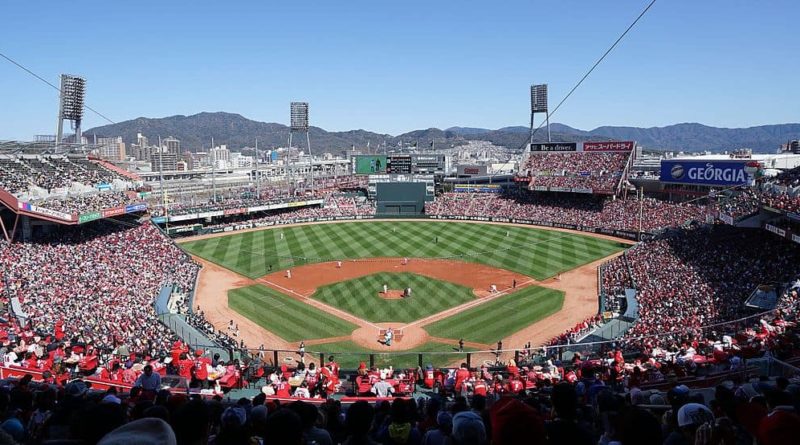
It was the newest stadium in Japan until 2023 (EsCon Stadium is up next) and everything is as you would expect in a country known for its convenience and efficiency. You will have a great view of the field from just about anywhere, concessions are excellent – don’t forget to try Hiroshima style Okonomiyaki – and it’s a short walk from the train station.
While most tourists come to Hiroshima for another reason – the sad and moving atomic bomb museum and memorials – catching a game at the ballpark is a great way to see the more modern and happier side of Hiroshima. In addition, there is the Mazda museum close by, and the general vibe of Hiroshima is quite cool – it’s a laid back, friendlier, and cheaper version of Japan’s huge cities, but there is still plenty to do.
If you’re thinking about coming to Hiroshima just for the atomic bomb museum, I would highly recommend staying an extra day or 2 to catch a game at the beautiful stadium and explore the other attractions in the city.
4) EsCon Field Hokkaido
- Location: Kitahiroshima, Hokkaido
- Built in: 2023
- Capacity: 35,000
- Team: Hokkaido Nippon-Ham Fighters
EsCon Field in Hokkaido is the newest NPB ballpark, as it opened in 2023. It definitely lives up to its name as the most modern stadium. It’s one of only 3 stadiums with natural grass, one of only two that has a retractable roof, and is surrounded by 80 acres of green space and retail.
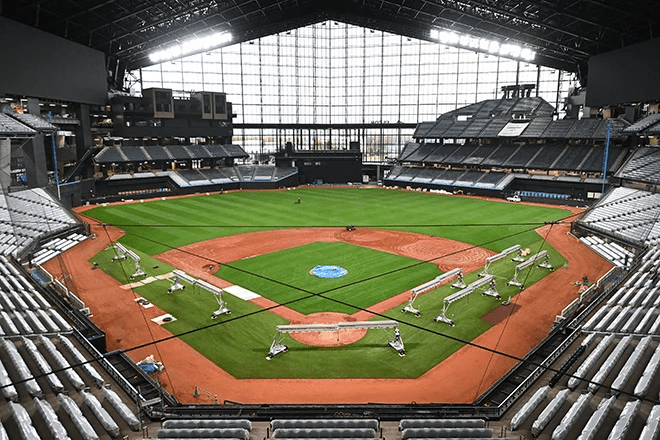
However, its most impressive feature is the huge glass wall beyond the outfield that has a traditional Hokkaido-style gable roof. Hokkaido is the northern island of Japan that gets a lot more snow than the mainland, so the gabled roof in the outfield and the big retractable roof give off the homey feel of a modern Hokkaido. Of course it also allows for the convenience of being able to play indoor or outdoor depending on the snowy or cold weather up north.
For those that don’t know, Yu Darvish and Shohei Ohtani, 2 of the most successful Japanese players to play in the MLB, both played for the home town Hokkaido Nippon-Ham Fighters. There is a giant mural of both players next to Tower 11, a five-story multipurpose building, including a hotel, named for the numbers of both legendary players.
EsCon field is unique in that it’s the only field that provides the “suburban ballpark” experience that is more common in America. There is a 4,000 car capacity parking area, a ballpark village concept, and even tailgating options in the parking lot. The stadium is similar to the Ranger’s Globe Life Field, and was even designed by the same architecture firm.
EsCon is very unique in terms of its moderness, architectural beauty, and not being close to a train station. But if you want to see Shohei Ohtani’s former team play and the more unexplored and natural parts of Japan in the northern island, you will not be disappointed with a visit to the newest NPB stadium. Who knows, perhaps this is the beginning of a new trend in Japanese ballpark design.
By the way if you think you have to take an expensive boat or a plane to the far away northern island of Hokkaido, think again, it’s Japan. There’s a bullet train that runs under the ocean that connects the two islands.
5) Tokyo Dome
- Location: Tokyo
- Capacity: 57,000
- Built in: 1988
- Team: Yomiuri Giants
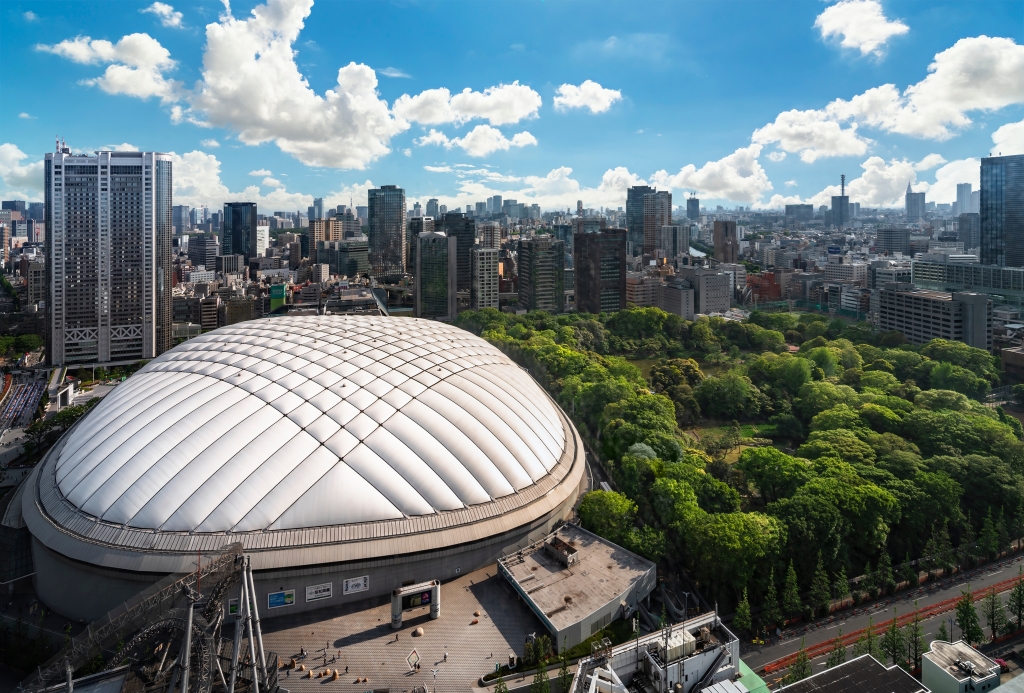
Ah, the famous Tokyo Dome. While it is definitely not the nicest stadium in Japan, it’s probably the most famous and recognizable one. To begin with, it’s the home of the Yomiuri (Tokyo) Giants, “the Yankees of Japanese baseball”, the team with 22 championships. It was also the team of Sadaharu Oh, the best Japanese player to ever play, and the NPB home run record holder with 868 longballs.
In addition, it’s arguably the biggest roofed stadium in the world (depending on how you count the seated or non seated capacity), and it holds tons of other sports games, concerts, and events. Lastly, it’s located in downtown Tokyo, making it the easiest stadium for tourists to get to.
I don’t particularly like baseball domes and wanted to put it lower on the list, but the legendary status of “the big egg” as its nicknamed means it needs to be up there with the best stadiums in Japan. The Japanese Baseball Hall of Fame is also located inside the Tokyo Dome, so if it’s the offseason or the Giants aren’t playing at home, you can still learn about Japanese baseball history and see the stadium.
It’s definitely more modern and touristy than the other stadiums so far on the list. If you miss Shake Shack or want to ride a roller coaster, get a spa, or buy American food at the MLB Cafe, then the Tokyo Dome is for you. But if you are looking for a more authentic Japanese baseball experience, with cheering fans, umbrella dances, and more Japanese cuisine, I would suggest taking the metro slightly farther to Meiji Jingu Stadium.
6) Rakuten Mobile Park Miyagi (Miyagi Baseball Stadium)
- Location: Sendai, Japan
- Capacity: 30,500
- Built in: 1950, big renovations in 2004
- Team: Tohoku Rakuten Golden Eagles
For the second time we head north of Tokyo – where most tourists don’t go. Rakuten Mobile Park does not look like a mobile park whatsoever, in fact it’s one of the nicer and more interesting stadiums in the NPB. The stadium is located in Sendai, a relatively unknown city to foreign tourists, even though it has a population of over 1 million.
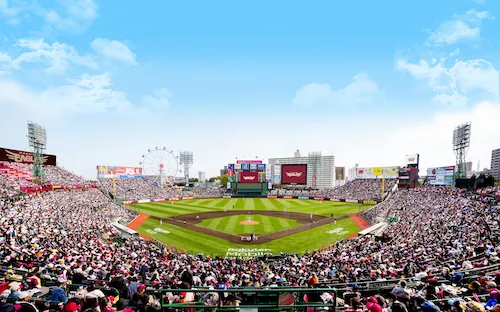
The ballpark is unique in that it’s the 3rd oldest stadium in Japan, but it had a few big renovations in recent years. The Tohoku Rakuten Golden Eagles are the newest expansion team in the NPB and when they were started in 2004, they only had a few months to renovate and upgrade the old stadium. After that was completed successfully within a few months, the deadly tsunami struck Northeastern Japan in 2011 and some more renovations were needed at the ballpark.
It does a really good job of combining the charming old elements with modern amenities and upgrades, and many people believe that Miyagi’s success led to the new style of stadiums we saw in Hiroshima and Hokkaido.
The famous ferris wheel in the outfield gives it a charming feel and because they added so many seats in 2004 to make it NPB-worthy, the outfield seats are basically on the field, another unique characteristic. Great concessions, good vibes, and beautiful views in the day or night gives Miyagi Baseball Stadium a worthy 6th place. If you’re a foreign tourist and make it here, you will probably be one of the only ones at the game.
7) Yokohama Stadium
- Location: Yokohama
- Built in: 1978
- Capacity: 34,000
- Team: Yokohama DeNa BayStars
Yokohama Stadium is located in Japan’s 2nd biggest city, but very few tourists stop in this giant city of almost 4 million in between visits to Tokyo, Kyoto, and Hiroshima. The stadium is quite beautiful, but without the history, modern amenities, or successful team that the other ballparks have, it receives a slightly lower ranking.
The Yokohama DeNa BayStars are a historically bad team as they’ve won only 2 Japan Series championships in 75 years, but catching a game here is still a great experience. The ballpark is smack in the middle of Japan’s biggest Chinatown and is easy to get to from Tokyo by train. Yokohama stadium is compared to Dodgers Stadium with the shape and big open outfield, but there are definitely no big parking lots around as it’s in the middle of a huge city.
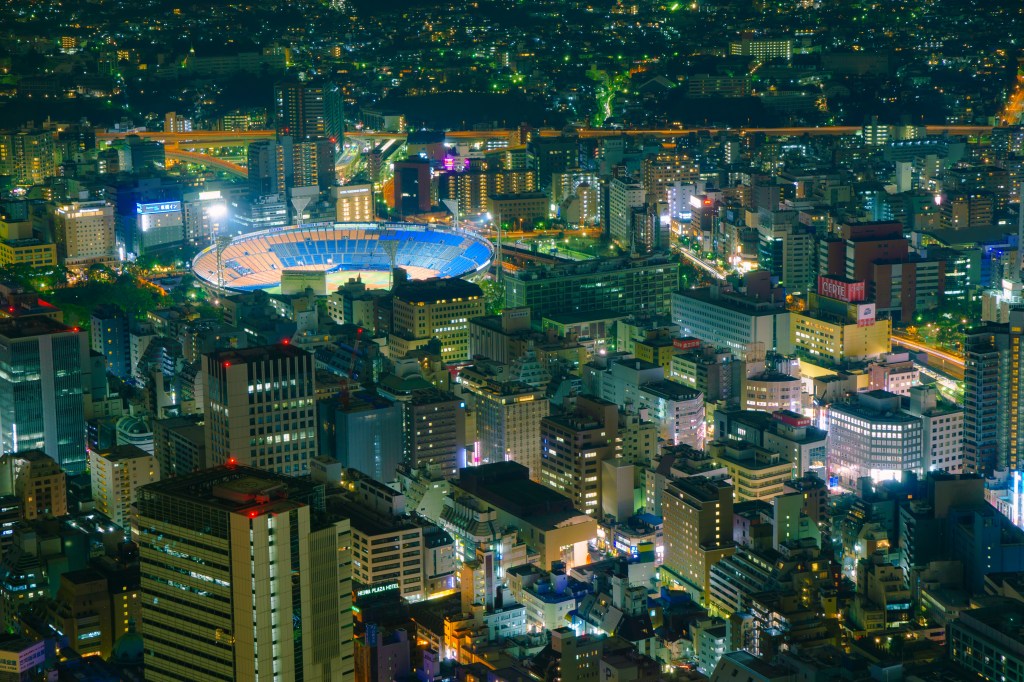
Around the ballpark you can find unique restaurants and shops in Chinatown as well as a ton of Japanese breweries and restaurants in the city. For those looking for a different experience than Tokyo, the beautiful stadium and fun urban experience could be a great evening. You can even stay in Tokyo and come to Yokohama as the train is less than an hour away, including the short walk to the ballpark.
8) Mizuho PayPay Dome
- Location: Fukuoka, Japan
- Built in: 1993
- Capacity: 40,000
- Team: Fukuoka SoftBank Hawks
The SoftBank Hawks are the most successful NPB franchise of the past decade as they absolutely dominated between 2014-2020, winning 6 of the 7 Japan Series championships during that time period. So if you want to see competitive baseball from a successful modern team then the PayPay Dome is a great place for that.
It was the first Japanese stadium to have a retractable roof, until Hokkaido joined them in 2023 and it also has the Sadaharu Oh museum close to the ballpark – as the Japanese baseball legend is currently the chairman of the Fukuoka Hawks.
Both of those are additional reasons to head to the stadium as seeing the retractable roof from inside is quite impressive. If that’s not enough, then the SoftBank fans have one of the coolest traditions of letting yellow jet balloons go up in synchronization before the bottom of the 7th inning.
While Fukuoku is not the first city on most tourists’ lists, there is actually quite a lot to do, with many ancient temples and some nice beaches to visit in the summer. In addition, there are ferries from Fukuoka to Busan, South Korea. So if you are thinking about visiting South Korea on the same trip, a ferry is a cool and often cheaper and more efficient option to get there. Then you also have an excuse to drag your travel partner along to the ballpark.
9) Kyocera Dome Osaka
- Location: Osaka
- Built in: 1997
- Capacity: 36,000
- Team: Orix Buffaloes
The Kyocera Dome, or simply the Osaka Dome, is one of the cooler domed stadiums in Japan. From the inside it looks like a spaceship, while from the outside it has a futuristic AI utopian look. The stadium is also easily accessible by train, and Osaka and nearby Kyoto are frequently visited by tourists making this a convenient stadium to attach to your itinerary.
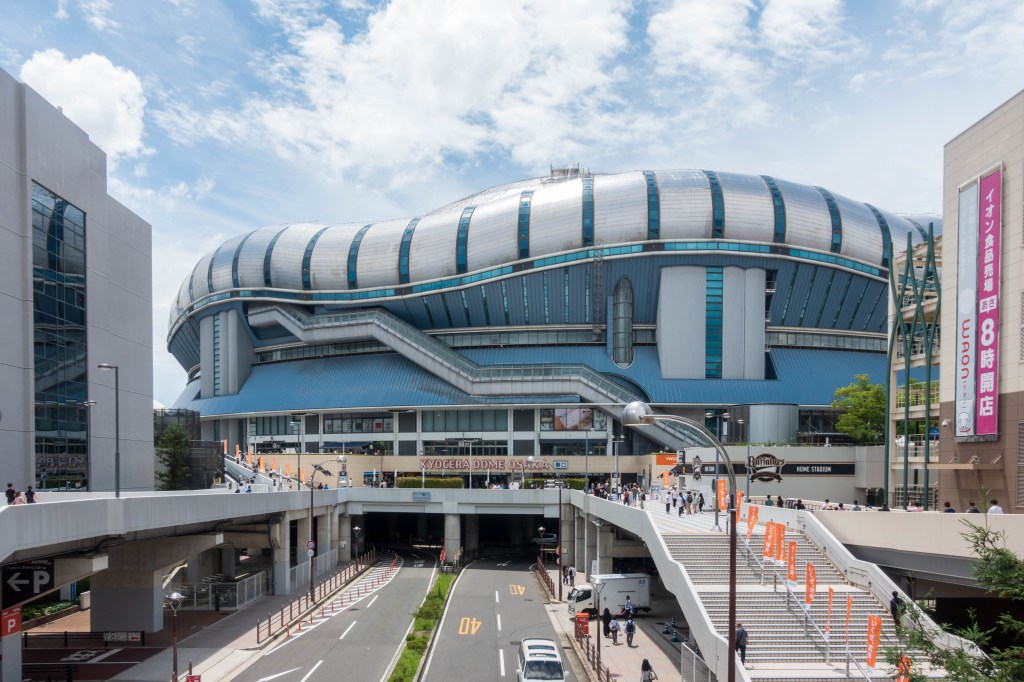
However, other than the cool shaped stadium, the fan experience here isn’t amazing as the food stands and cheering sections aren’t as good as other ballparks. But the hometown Orix Buffaloes have improved tremendously as they won 3 straight pennants from 2021-23 including winning it all in 2022, so the fans should be a little more excited now than they are traditionally known for.
10) ZoZo Marine Stadium
- Location: Chiba, East of Tokyo
- Built in: 1990
- Capacity: 30,000
- Team: Chiba Lotte Marines
Japanese ballparks offer a lot of variety, and catching a game at ZoZo Marine Stadium will take you back to the multi-use American ballparks built in the 1960’s and 70’s. These stadiums such as Three Rivers Stadium in Pittsburgh, Riverfront Stadium in Cincinnati, and Veterans Stadium in Philadelphia, all had round concrete structures for efficiency and were usually built next to the water.
ZoZo Marine Stadium is just that. It’s not particularly beautiful, but the hometown Chiba Lotte Marines have a dedicated fan base and there is lots of cheering going on. Another interesting aspect is that since it’s an open air stadium on the water, the early spring and late fall games provide a chilly breeze that you don’t get in most other stadiums – kind of a similar cold breeze coming off the bay in early April at Oracle Park in San Francisco.
If you miss the old American multi use stadiums that are no longer around, want some good baseball, energetic fans, and don’t mind going a bit out of the way from Tokyo, then ZoZo Marine Stadium is for you.
11) Belluna Dome
- Location: Northwest Tokyo
- Built in: 1979
- Capacity: 32,000
- Team: Saitama Seibu Lions
If it feels like half of the baseball stadiums in Japan are in or around Tokyo – that’s because they just about are. But that’s what happens when you have a city with the biggest metropolitan area in the world with 40 million people.
The Belluna Dome has had a lot of stadium name changes over the years and the team has had quite a bit of success with 13 Japan Series championships, but the stadium just doesn’t provide the best experience. The stands usually aren’t full and the domed stadium doesn’t really have any stand out features except for one thing – The roof was added on after the stadium was built so there are no walls. This means you can look out beyond the gap between the roof and the stadium – the only one like that in Japan.

However, this is also its biggest downside. Being an incredibly humid country and having huge gaps with a closed dome means that all the heat and humidity gets in and then gets trapped. On hot and humid days, it can be pretty miserable, but when the weather is nice, having a closed dome that feels a bit open can be a cool experience.
Either way, unless you are trying to make a point of going to all 12 NPB stadiums, you probably won’t make it to the Belluna Dome as there are plenty of better options the same distance or less from downtown Tokyo.
12) Vantelin Dome Nagoya
- Location: Nagoya
- Built in: 1997
- Capacity: 36,500
- Team: Chunichi Dragons
One of them has to be in last place. Although there is no such thing as a bad stadium in Japan – after all it’s still a high level of baseball, inexpensive, incredible food and drink, and a really cool experience – there are definitely better stadiums than the Nagoya Dome.
The dome isn’t old enough to be a nice throwback and it’s not new enough to have comfortable or cool amenities, so it’s just kind of there. But it’s Japan and everything has something unique. The Nagoya Dome’s thing is that it lights up after the hometown Chunichi Dragons win.
You probably won’t find yourself in Nagoya – after all it’s just a “small” Japanese city of 2.3 million people that most people pass on the bullet train from Tokyo to Kyoto. But if you are there and make it to a game, you will still have a great time because Japanese baseball is awesome no matter what ballpark you go to.
Wrapping it up
There you have it, all of the Japanese baseball stadiums ranked in order. I hope it helps you get a feel of what type of stadium and vibe you would want to go to in order to maximize your experience. While you can’t go wrong by going to any Japanese baseball game, if you can make it to one of the top 5 you will see something extra cool.
 Baseball in Japan - Your Guide to Nippon Professional Baseball
Leave a comment