
The highest level of Japanese baseball, the Nippon Professional Baseball League (NPB), is simply awesome. There is great competition, interactive fans, and a long history. Simply put, it’s everything you need in a sports league.
I fell in love with it while attending a live game in Tokyo, but you don’t need to travel all the way to Japan to appreciate the second highest level of baseball in the world.
So how exactly does the NPB work and what are the differences between the MLB and the NPB? This article will cover all the basics.
How does the NPB work?
The NPB is made up of 12 teams which are divided into 2 different leagues, the Central League and the Pacific League. The teams are split evenly 6 and 6 (you would think this is obvious but for years the NL Central had 6 teams while the AL West had 4 teams until they moved the Astros to the AL West to make it an even 5 teams in each division).
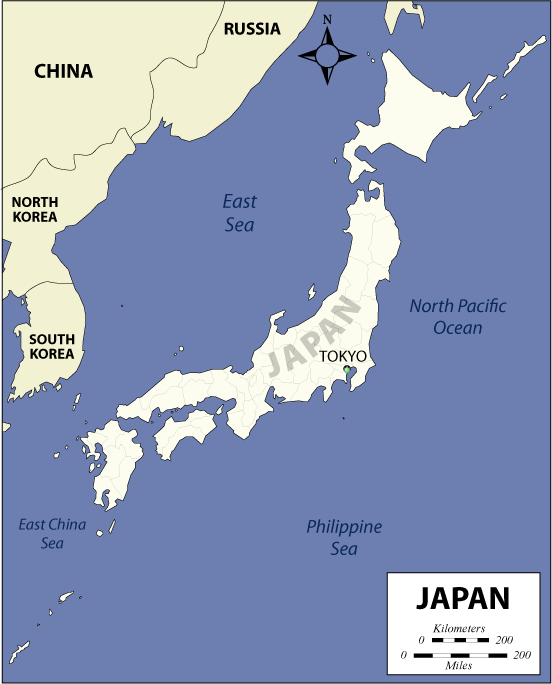
Since Japan is shaped sort of like a banana, there isn’t really an East and West or a North and South so they divided it up into Pacific and Central.
Much like the MLB, the NPB has gone through many changes with expansion and disbanding teams, the number of games in the schedule, and how many interleague games are played. Starting in 2007, both leagues adopted a standard 143 game season.
The scheduling goes like this for each team:
- Play each of the 5 other teams in your league 25 times for a total of 125 games
- Play each of the 6 interleague teams 3 times for a total of 18 games.
Much like European soccer, there is a midseason tournament where a separate smaller “champion” is crowned from the team with the best record after the 18 interleague games played.
NPB Playoffs
Similar to the MLB, the NPB playoffs consist of the winner of each league facing off in a championship series – in this case it’s called the Japan Series, instead of the World Series (non-Americans like to laugh at this because the MLB winner is not the world winner).
However the playoff format is quite different from the MLB. Japanese baseball combines elements of pre-divisional era MLB playoffs with modern MLB playoffs. What does that mean?
For those that don’t know, before 1969, the MLB was made up of 2 leagues – the American League and the National League where each league had 10 teams with no divisions (Central, East, West). The playoffs were quite simple – the team in the National League with the best record and the same in the American League were crowned the pennant winners at the end of the season and faced off in the World Series. (In 1969, it changed to 2 divisions in each league – the East and the West – and the winner of each division played in the League Championship Series where the winner went on to the World Series).
In the NPB, the team with the best record from each league is crowned the pennant winner, but they don’t automatically make it to the Japan Series championship. Instead, they receive a bye while the 2 and 3 seeded teams face off in a best of 3 game playoff series where all the games are played at the 2 seed’s home stadium.
The winner of that “wild card” matchup between the 2 seed and the 3 seed then faces off against the top seeded pennant winner in a best of 7 series, called the Climax Series, where all games are played at the top seed’s home stadium.
But there’s a catch!
The number 1 seed starts off with an automatic 1-0 game advantage, meaning they only need to win 3 games to win the series, while the lower seeded team needs to win 4.
My guess is that the NPB is going through what most sports leagues are debating about: They want to keep the old school elements that made the sport so popular, but also need to keep the sport modern, interesting, and most importantly, profitable.
So this is their way of combining the both. It definitely gives a big advantage to the top seeded team, but hey, they deserve something for being the best team over a 143 game season in the grueling Japanese summer heat and humidity. Plus, the 2nd or 3rd seed teams still have a shot at winning the championship, although it’s quite difficult.
The winner of each of these series then face off in the Japan Series where home field is decided by what year it is – The Central League gets home field advantage in even years while the Pacific League gets home field advantage in odd years.

Important note: The pennant winner is determined by the regular season record alone, while the winner of the Climax Series makes it to the championship. This means there is a possibility that the pennant winner won’t make it to the Japan Series despite the big advantages they have with the bye, a 1-0 start, and home field advantage. In fact it’s happened 4 times since the modern NPB playoff format was standardized for both leagues in 2007.
Rule differences between the NPB and MLB
I will cover all of the detailed differences between the NPB and the MLB in a different post, but these are the main ones that affect the game:
Designated Hitter – Just like the MLB – until a few years ago – the NPB also has the weird half/half DH rule. The Pacific League uses the DH, while the Central League does not have a DH. The only exception is during interleague games when the Pacific League team is the home team. (For all you baseball purists who miss pitchers hitting, the Pacific League still provides that entertainment.)
Baseball size and feel – The NPB baseballs have seams closer together which makes it easier to put spin on it. They are also known to be a bit “stickier” which also helps with grip.
Ballpark size – NPB has more standardized ballpark dimensions that are smaller on average than the MLB. In general there are less weird things like Fenway Park, which has a 37 foot Green Monster in left field to go along with a 3 foot right field wall. NPB stadiums have much more standard dimensions of distance and outfield wall height (generally 13 feet).
Ties – Unlike the MLB, NPB games can end in a tie. There are up to 3 extra innings, meaning the longest game can be 12 innings. While every baseball fan likes to watch the highlights of an 18 inning walk off game the next morning, the small amount of fans that remain until the end of the game show that it’s not too popular among both players and fans.
There are many other smaller differences and cultural differences, both in the style of play and especially in the fan experience but these are the main, practical ways that the NPB differs from the MLB.
Let’s sum up the makeup of the NPB:
- 12 teams altogether made up of 2 leagues with 6 teams each
- 143 game regular season
- 125 games against your league’s opponents and 18 games of interleague play
- A mid season champion is crowned from the winner of interleague play
- Top 3 teams from each league make the playoffs (6 alltogether)
- The top seeded team is the pennant winner and receives a bye
- 2 and 3 seeded teams play each other in a best of 3 wild card series
- The winner of that plays the number 1 seed in the Climax Series
- The winners of the Climax Series in each league play each other in the championship – Japan Series
 Baseball in Japan - Your Guide to Nippon Professional Baseball